Crochet Hook Case Pattern

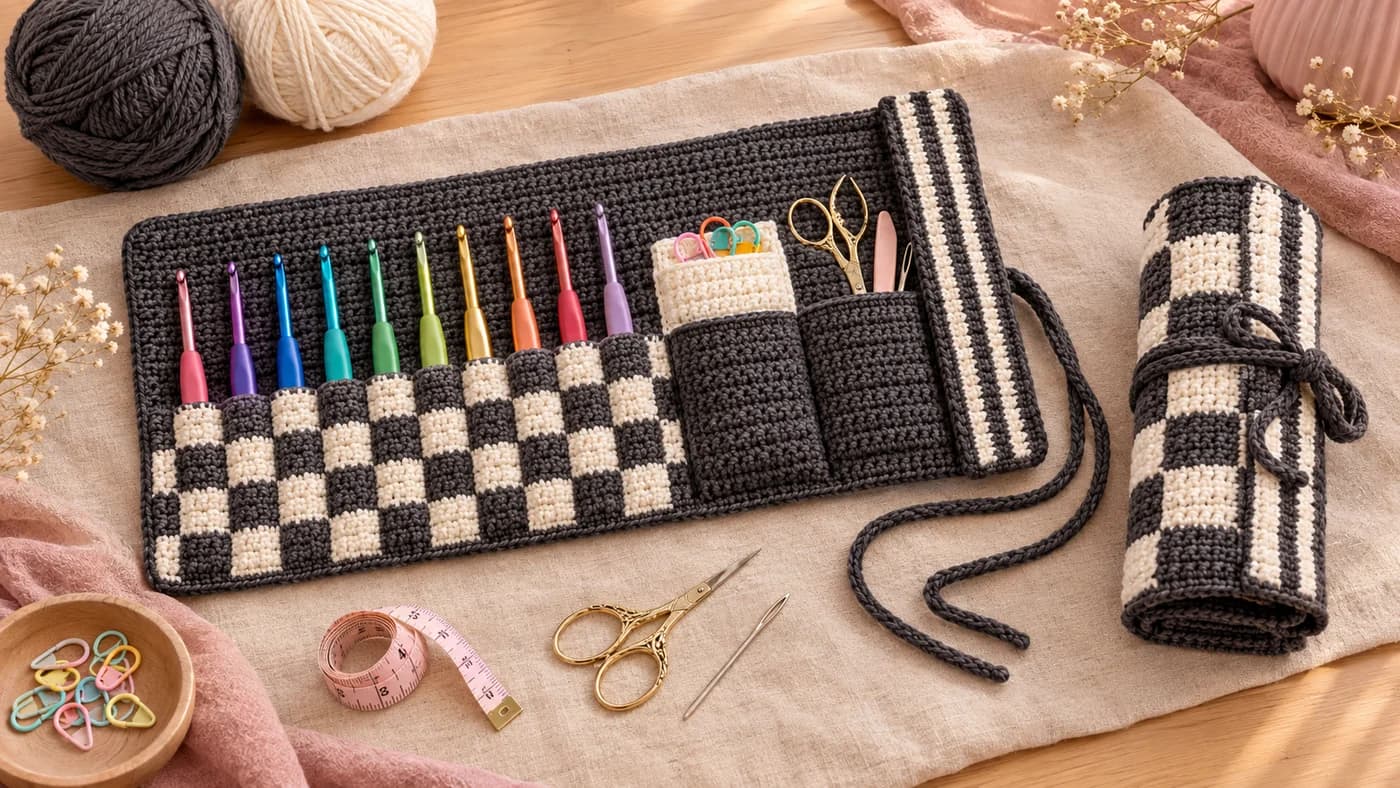
This free crochet hook case pattern makes a charcoal and white checkerboard roll-up with 11 hook slots, two notions pockets and a small pocket for your tape measure. It's five flat pieces in half double crochet, joined by one round of edging. You'll need about 210 yards of worsted cotton in two colors, a 5 mm hook and 5 to 7 hours. Open, it's about 18.5 by 8.5 inches. Rolled and tied, it slips into any project bag.
Key Takeaways
- Five pieces: a back panel, a checkerboard pocket strip, a striped flap, a small pocket and a chain tie.
- 11 hook slots: 3 wide ones for soft-grip handles and 8 slim ones for aluminum or steel hooks.
- Budget ~210 yd (192 m) of worsted #4 cotton: about 160 yd charcoal and 55 yd white.
- One new trick: the checkerboard uses tapestry color changes, one every 4 stitches.
Why I love this hook case
For years my hooks lived in a jar, a pencil case and the bottom of three project bags. I'd find a 4 mm in the couch cushions and still not find the 5 mm. This roll-up fixed that in one afternoon of sewing. Every hook has its own slot, so I can see at a glance which one is missing.
The checkerboard is the fun part. It looks fussy, but it's just 4 stitches of one color, 4 of the other, and a swap every 3 rows. Everything else is plain rows of half double crochet in charcoal, which is perfect TV crochet.
It's also the gift I make most for crochet friends. It rolls up small, it looks polished, and nobody who crochets has enough places to put their hooks.
Skill level. Easy. You need chains, half double crochet and single crochet, plus mid-row color changes for the checkerboard. If you've never carried a second color inside your stitches, my ocean wave crochet coaster is a small first try at the same technique.
What you'll need
Yarn: worsted #4 cotton, such as Lily Sugar 'n Cream (about 120 yd / 71 g per solid-color ball). Cotton gives firm pockets that hold their shape and don't stretch when you slide a hook in. For the white, a warm off-white like Soft Ecru looks lovely next to charcoal.
| Color | Used for | Amount |
|---|---|---|
| Charcoal (or black) | Back panel, half the checkerboard, 5 flap stripes, edging, tie, sewing | about 160 yd (2 balls) |
| White | Half the checkerboard, 6 flap stripes, small pocket | about 55 yd (1 ball) |
I counted the stitches to get those numbers: about 2,050 half double crochet, a round of edging and the tie. Plan on 190 to 235 yd in total, depending on your tension.
Hook and notions
- 5 mm (US H-8) hook.
- A tapestry needle and scissors.
- About 20 locking stitch markers or pins, for the assembly.
- A ruler or tape measure.
Gauge and finished size
14 hdc and 11 rows = 4 in (10 cm) in half double crochet. Stitch gauge matters here, because the pocket strip has to match the back panel's width. If you have more stitches, go up a hook size. If you have fewer, go down one.
Finished case: about 18.5 in (47 cm) wide and 8.5 in (22 cm) tall when it's open, edging included. The back panel is about 14 in wide and the flap is 4 in wide. Rolled up, the case is about 8.5 in tall and 3 in across.
Each checkerboard block is 4 stitches by 3 rows, a little over 1 in (2.8 cm) square.
Abbreviations (US crochet terms)
- ch = chain
- sl st = slip stitch
- sc = single crochet
- hdc = half double crochet
- st(s) = stitch(es)
- RS = right side
- WS = wrong side
Turning chain. In every piece, the ch 2 at the start of a row doesn't count as a stitch. Work the first hdc into the first stitch.
Color change in hdc. Work the last hdc of a color until you have 3 loops on the hook. Drop the old color, yarn over with the new color and pull it through all 3 loops. The next stitch is in the new color.
Carrying the color you're not using. Lay the unused strand along the top of the row you're working into, and work each hdc over it, so it's hidden inside the stitches. Keep it relaxed. If you pull it tight, the fabric puckers.
UK crocheters: this pattern uses US terms. US single crochet = UK double crochet, and US half double crochet = UK half treble.
The pieces at a glance
| Piece | Make | Size | Colors |
|---|---|---|---|
| Back panel | 1 | 48 sts × 22 rows (14 × 8 in) | charcoal |
| Pocket strip | 1 | 48 sts × 12 rows (14 × 4.4 in) | 12 × 4 checkerboard |
| Flap | 1 | 14 sts × 22 rows (4 × 8 in) | 11 two-row stripes, white at both ends |
| Small pocket | 1 | 14 sts × 8 rows (4 × 2.9 in) | white |
| Tie | 1 | ch 110 (about 34 in) | charcoal |
The back panel and the pocket strip both start with ch 50, so they're the same width. The back panel and the flap both have 22 rows, so they seam row to row.
The pattern — step by step
Part 1 — The back panel and the flap
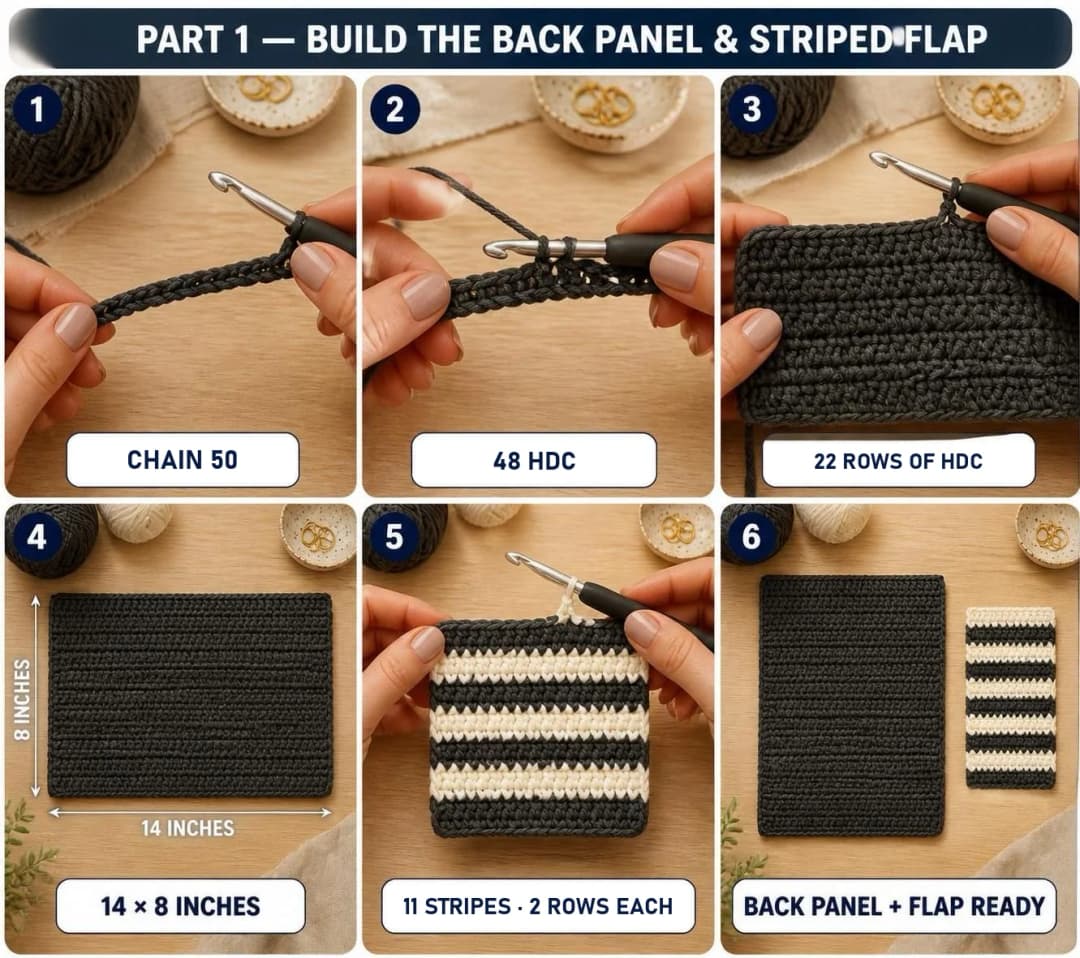
Back panel (charcoal):
- Foundation: Ch 50.
- Row 1: Hdc in the 3rd ch from the hook and in each ch across. (48 hdc)
- Rows 2–22: Ch 2, turn. Hdc in each st across. (48 hdc)
- Fasten off and weave in the ends. It should measure about 14 in wide and 8 in tall.
Flap (white and charcoal stripes): Each stripe is 2 rows. Change colors on the last hdc of every even row, from Row 2 to Row 20. Carry the unused color up the side edge instead of cutting it. The edging will hide it later.
- Foundation: In white, ch 16.
- Row 1: Hdc in the 3rd ch from the hook and in each ch across. (14 hdc)
- Row 2: Ch 2, turn. Hdc in each st across, changing to charcoal on the last st. (14 hdc)
- Rows 3–4: Work in charcoal, changing to white on the last st of Row 4.
- Rows 5–20: Keep going the same way: 2 rows white, 2 rows charcoal.
- Rows 21–22: Work in white.
- Fasten off, leaving a 30-in (75 cm) white tail. Weave in the charcoal end.
You now have a flap of 11 stripes, 6 white and 5 charcoal, with white at the top and bottom. It's 4 in wide and the same height as the back panel.
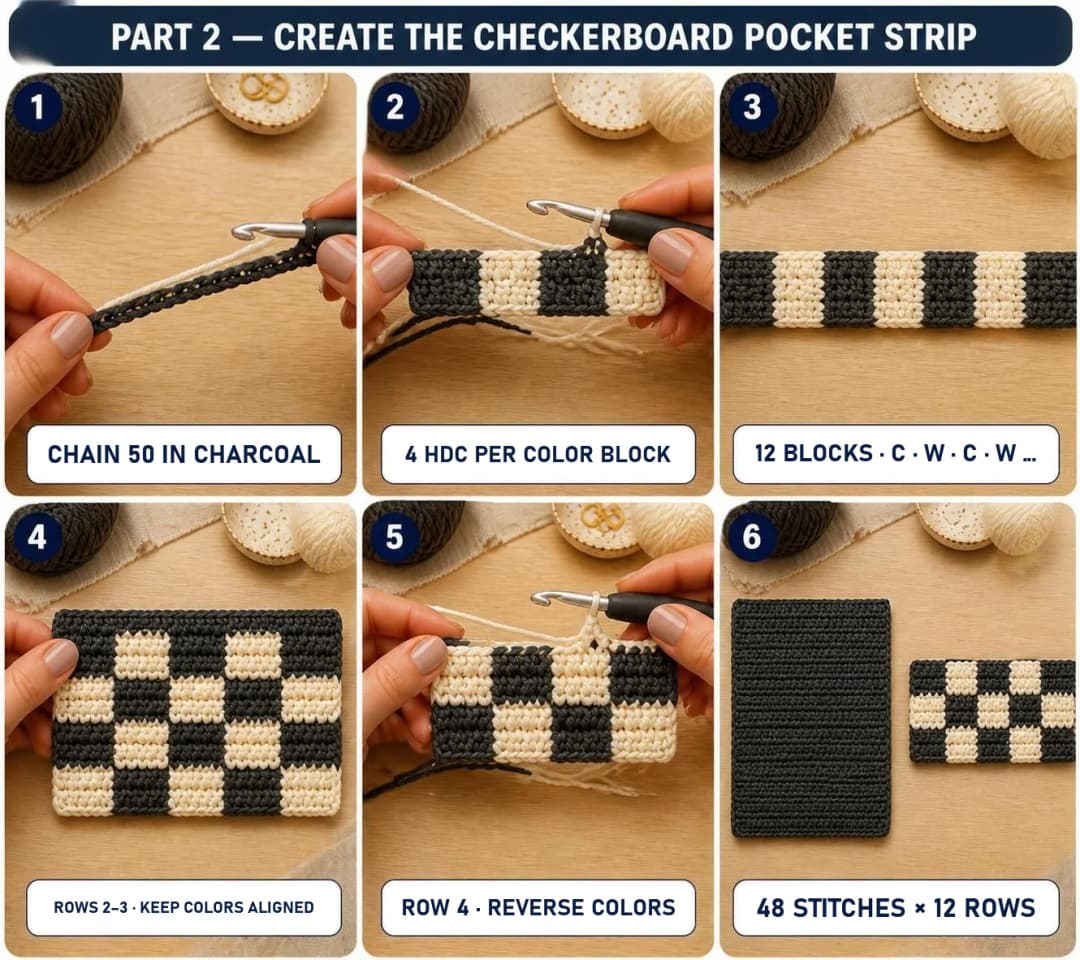
Part 2 — The checkerboard pocket strip
The strip is 4 rows of blocks. Each block is 4 hdc wide and 3 rows tall, so each row of blocks has 12 blocks: 6 charcoal and 6 white, in turn.
- Foundation: In charcoal, ch 50. Lay the white yarn along the chain and leave a 4-in white tail.
- Row 1: Hdc in the 3rd ch from the hook and in each of the next 3 ch, working over the white strand, and change to white on the 4th hdc. Keep going across in groups of 4 hdc: white, then charcoal, then white, changing color on the 4th hdc of each group. Carry the other color the whole way. The row ends with a white block. (48 hdc: 12 blocks)
- Rows 2–3: Ch 2 in white, turn. Work every block in the same color as the block below it. (48 hdc) On the last hdc of Row 3, change to charcoal.
- Row 4: Ch 2 in charcoal, turn. Now the colors swap: work every block in the opposite color of the block below it. (48 hdc)
- Rows 5–6: Work every block in the same color as the block below it. On the last hdc of Row 6, change to the other color.
- Rows 7–9: Swap again. Every block is the opposite of the one below it. On the last hdc of Row 9, change to the other color.
- Rows 10–12: Swap one last time. (48 hdc)
- Fasten off both colors and weave in the ends.
The rule is simple: 3 rows the same, then swap. On the last hdc of Rows 3, 6 and 9, change to the color of the first block of the next row, and make the turning chain in that color.
Check your strip against the back panel. Lay one on top of the other. They should be the same width, give or take half an inch. Tapestry rows often come out a little tighter. If yours is more than half an inch narrower, redo it with a 5.5 mm hook.
Look at both sides and pick the neater one as the RS. On one side, the carried charcoal usually peeks through the white a little less.
Part 3 — The small pocket and the tie
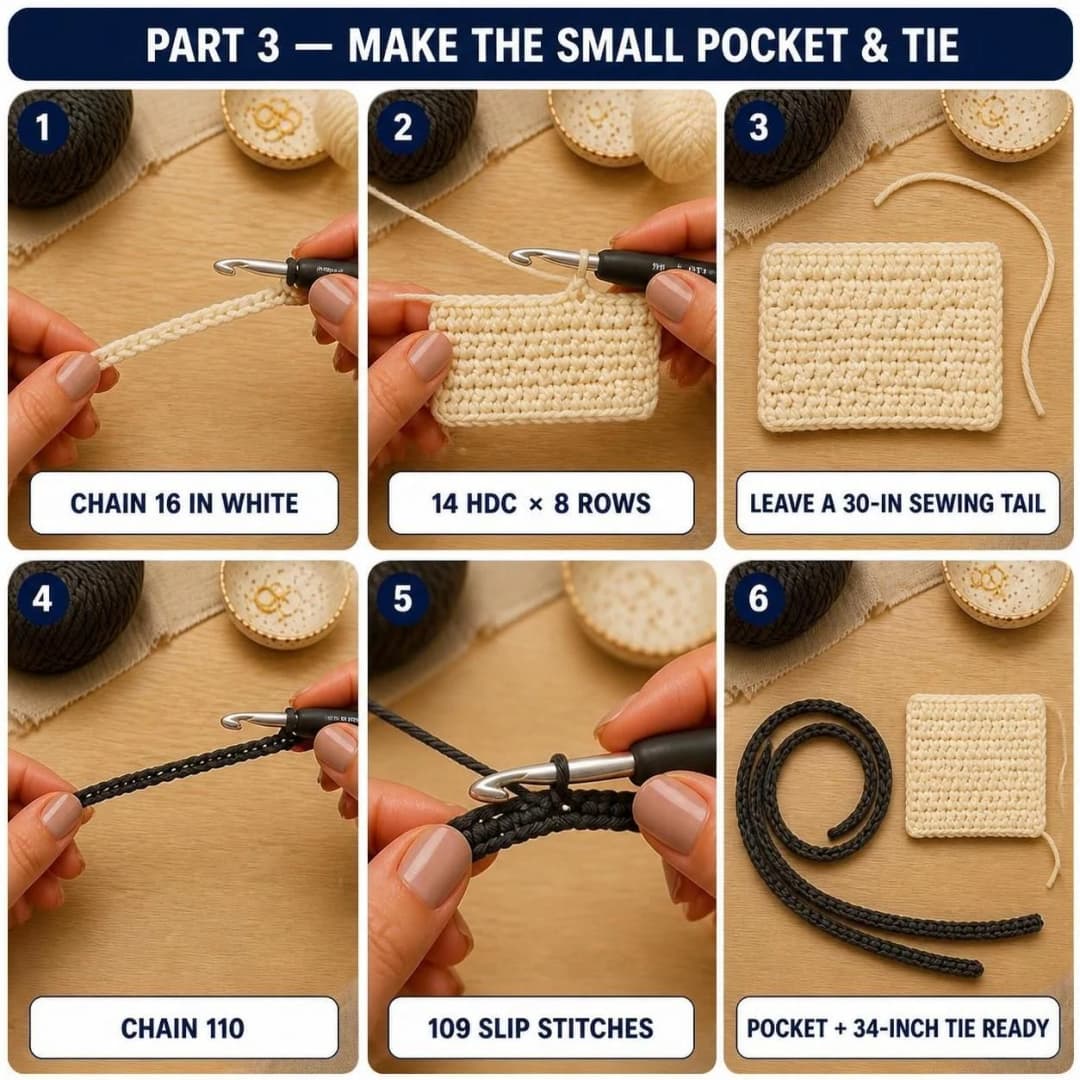
Small pocket (white):
- Foundation: Ch 16.
- Row 1: Hdc in the 3rd ch from the hook and in each ch across. (14 hdc)
- Rows 2–8: Ch 2, turn. Hdc in each st across. (14 hdc)
- Fasten off, leaving a 30-in (75 cm) tail for sewing.
Tie (charcoal):
- Leave a 6-in (15 cm) starting tail and ch 110.
- Sl st in the back bump of the 2nd ch from the hook and of each ch across. (109 sl st) The slip stitches make a firm cord that doesn't curl.
- Fasten off, leaving a 6-in (15 cm) tail. Weave both tails back into the cord, so the two ends are clean.
The tie is about 34 in long. You'll sew it on by its middle, so it makes two 17-in ends that wrap around the roll.
Part 4 — Put the case together
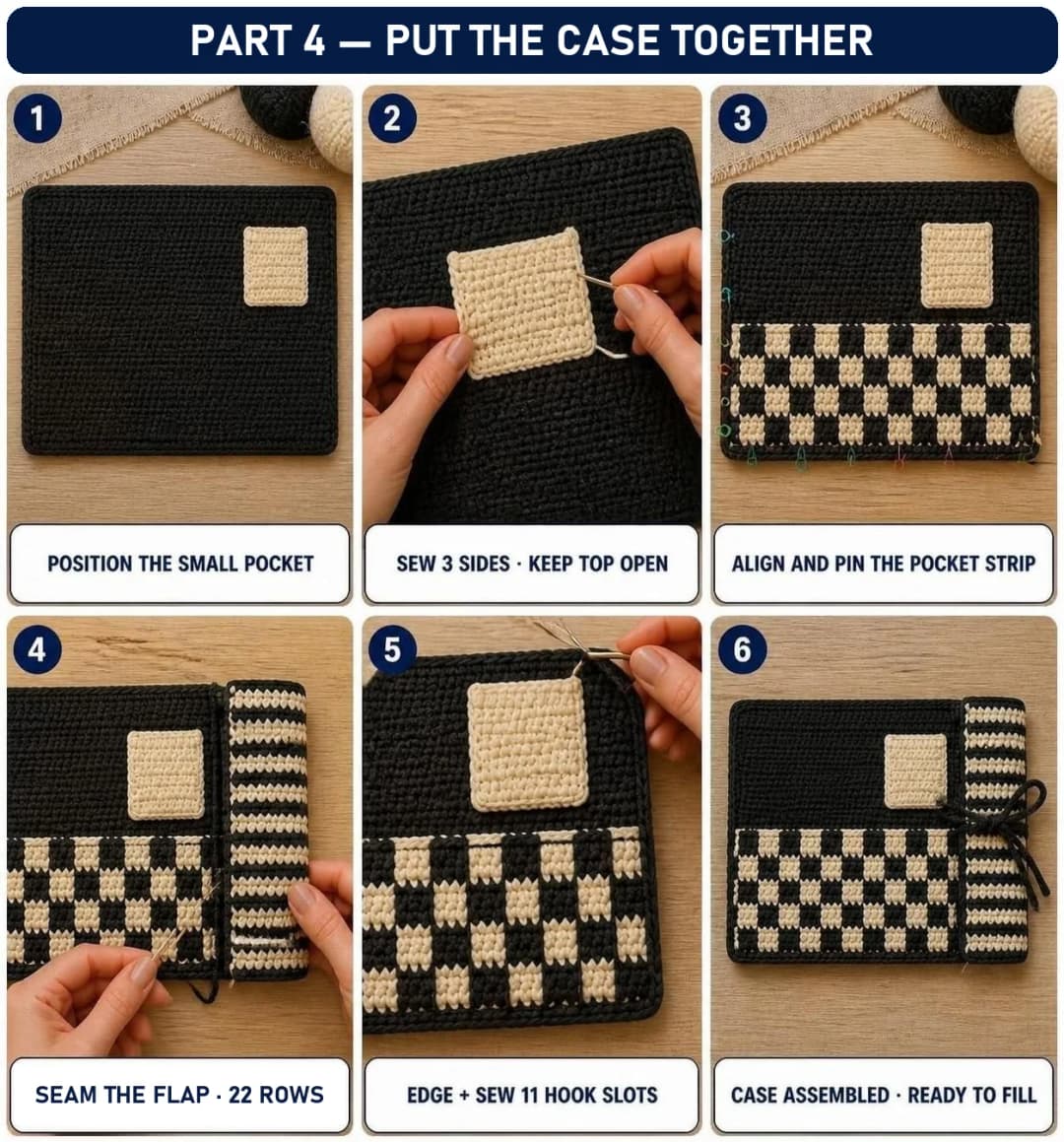
Lay the back panel RS up, with the foundation chain at the bottom. From here on, "left" and "right" mean the case as you look at it, open, with the flap on the right.
- Sew on the small pocket. Place it on the right half of the back panel, above where the pocket strip will go: its bottom edge on Row 14 of the back panel and its top edge on Row 21. Its sides line up with stitches 34 and 47, counted from the left edge. That leaves one free column next to the right edge for the seam. Pin it, then whipstitch the two sides and the bottom with the white tail. Leave the top open.
- Place the pocket strip. Lay it RS up on the back panel, with its bottom edge and side edges lined up with the back panel's. Pin the bottom corners, the left side and every few blocks along the bottom.
- Seam on the flap. Put the flap next to the right edge of the back panel, RS up, with Row 1 of the flap next to Row 1 of the back panel. Whipstitch the two side edges together with the white flap tail, one row-end to one row-end, all 22 rows. For the bottom 12 rows, go through three layers: the flap, the back panel and the pocket strip's right edge. That closes the pocket on that side. The seam is also the fold line for the flap.
- Edge everything in one round. Join charcoal at the top left corner of the back panel. Work 1 round of sc all the way around the case, back panel and flap together: 1 sc in each st across the top and bottom, 3 sc over every 2 row-ends along the two short sides, and 3 sc in each corner. Where the pocket strip sits, along the bottom and the lower left side, work through both layers. That closes the bottom and the left side of the pocket. Join with a sl st to the first sc and fasten off. (about 198 sc)
- Sew the slot dividers. Each divider is a straight line of backstitch, through both layers, running between two columns of stitches from the bottom of the pocket to its top. Count stitches from the left edge. Sew a divider after each of these stitches: 4, 8, 12, 14, 16, 18, 20, 22, 24, 26, 28 and 40. Go right up to the top edge of the pocket and back down 2 stitches, so the top of each divider can't pull loose.
- Sew on the tie. Turn the case over, WS up. Find the flap seam and the middle of its height, between Rows 11 and 12. Fold the tie in half and sew the fold to that spot, just on the back panel side of the seam, with about 10 stitches through the tie and the back panel. Go deep, because this spot takes a tug every time you tie the case.
Your slots now are:
- 3 wide slots (4 stitches each, about 1.1 in) on the left, for soft-grip or ergonomic hooks. Each one lines up with one checkerboard block.
- 8 slim slots (2 stitches each, about 0.6 in), for aluminum, bamboo and steel hooks. They split the next 4 blocks in half.
- A 3.4-in notions pocket (stitches 29 to 40) for small scissors or a stitch-marker pouch.
- A 2.3-in pocket (stitches 41 to 48) for a needle case, a pencil or a row counter.
I sew every divider in charcoal. On the white blocks it shows as a thin dark line, which I like, because it looks like piping. If you'd rather hide it, switch to white where the divider crosses a white block.
Part 5 — Fill it, fold it and roll it
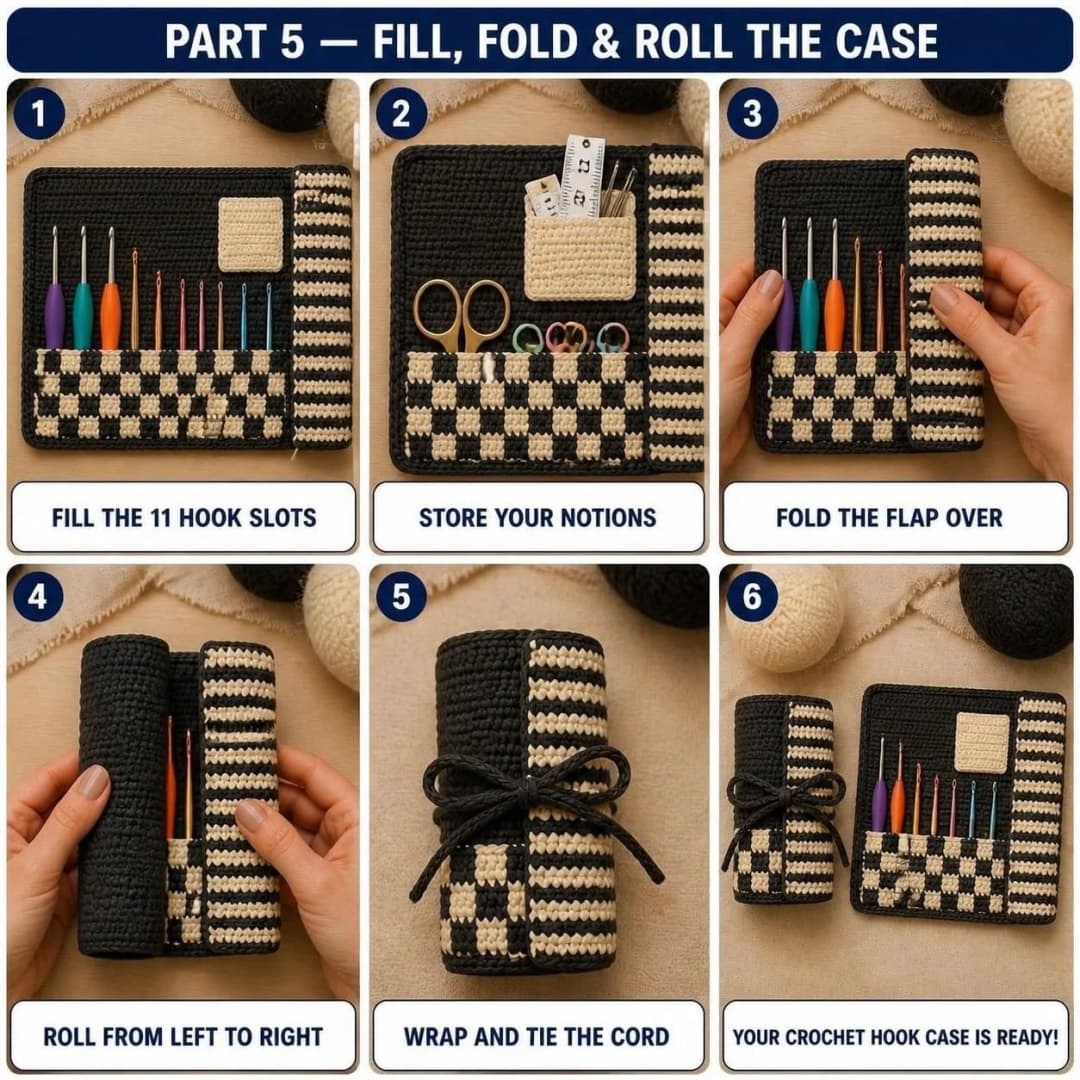
- Load the slots. Put your soft-grip hooks in the 3 wide slots on the left, then your slim hooks from smallest to largest. Your tape measure and tapestry needles go in the small upper pocket, and scissors and stitch markers go in the notions pocket.
- Fold the flap to the left, over the notions pockets and the small pocket.
- Roll the case from the left edge toward the flap, keeping the hooks straight and the roll snug.
- Tie it. Wrap both ends of the tie around the roll in opposite directions and tie them in a bow on the front.
A snug roll holds the hooks in place in a project bag. If you're going to toss it around in a backpack, add the top flap from the variations below, so the hook heads can't slide out the top.
Care. Take out the hooks and notions first. Hand wash in cool water, or machine wash on a gentle cycle in a mesh bag. Press the water out in a towel and dry it flat. Cotton shrinks a little in a hot dryer, so skip it.
Make it yours — quick variations
| Variation | Change from base pattern |
|---|---|
| Top flap (for backpacks) | In charcoal, ch 50 and work 48 hdc × 8 rows. Whipstitch it to the top edge of the back panel before the edging, so it folds down over the hook heads. Add about 45 yd charcoal. |
| More hook slots | Make the back panel and pocket strip 60 sts wide (ch 62, 15 blocks). The extra 12 stitches make 6 more slim slots. Add about 45 yd. |
| All ergonomic hooks | Sew a divider after every 4th stitch up to stitch 28, for 7 wide slots, one per block. |
| Brush or pen roll | Same pattern. Use the slim slots for makeup brushes or pens, and the notions pocket for a compact or an eraser. |
| Softer palette | Try sage and cream, or blush and navy. Keep the checkerboard in two colors with strong contrast, so the blocks read clearly. |
| Stripes instead of checks | Work the pocket strip in 3-row stripes, changing color only at the end of a row. No carrying, and no show-through. |
Troubleshooting the three things that go wrong
The pocket strip is narrower than the back panel
Tapestry crochet pulls tighter than plain rows, because every stitch wraps around a carried strand. Go up half a hook size for the pocket strip only. A very small difference, under half an inch, disappears when you pin the corners and work the edging.
Charcoal shows through the white blocks
A little peeking is normal with carried colors, and it's why the neater side becomes the RS. To cut it down, keep the carried strand along the top of the stitches, not dangling behind them, and don't pull it tight. If you want zero show-through, use the stripes variation.
The hooks fall out of the slots
Either the slots are too wide for your hooks, or the roll is too loose. Add an extra divider through the middle of a wide slot to make two slim ones. Then roll the case more firmly before you tie it, or add the top flap.
Frequently asked questions
How many crochet hooks does this case hold? It has 11 hook slots: 3 wide slots for soft-grip or ergonomic handles, and 8 slim slots for aluminum, bamboo or steel hooks. There's also a 3.4-in notions pocket, a 2.3-in pocket and a small upper pocket, so scissors, a tape measure and needles fit too. The "more hook slots" variation takes it to 17.
Will my ergonomic hooks fit? Most soft-grip hooks, like Clover Amour or Boye Ergonomic, fit the three 4-stitch slots, which are about 1.1 in wide. Chunky handles, like wooden ergonomic hooks with a big bulb, may be tight. For those, sew the dividers every 5 or 6 stitches instead. The pocket is about 4.4 in deep, so hooks up to about 7.5 in long fit inside the case.
How long does this hook case take to crochet? About 5 to 7 hours in total. The back panel takes about 2 hours, the checkerboard strip about 1.5 hours and the flap, small pocket and tie about 1 hour together. The assembly, edging and dividers take another 1 to 1.5 hours.
Can I use acrylic yarn instead of cotton? Yes, any worsted #4 yarn works if it matches the gauge. Acrylic is softer and stretchier, so the slots loosen a little over time and slim hooks can slide around more. Cotton keeps the pockets crisp and firm. If you use acrylic, sew the dividers a little closer, or go down half a hook size.
Can I sell hook cases made from this pattern? Yes, you're welcome to sell finished hook cases made from this free pattern at markets, on Etsy or as gifts. Please credit "Pattern by Wavode" in your listing and link back to this page. What you can't do is republish this write-up or my photos as your own pattern.
Related patterns on Wavode
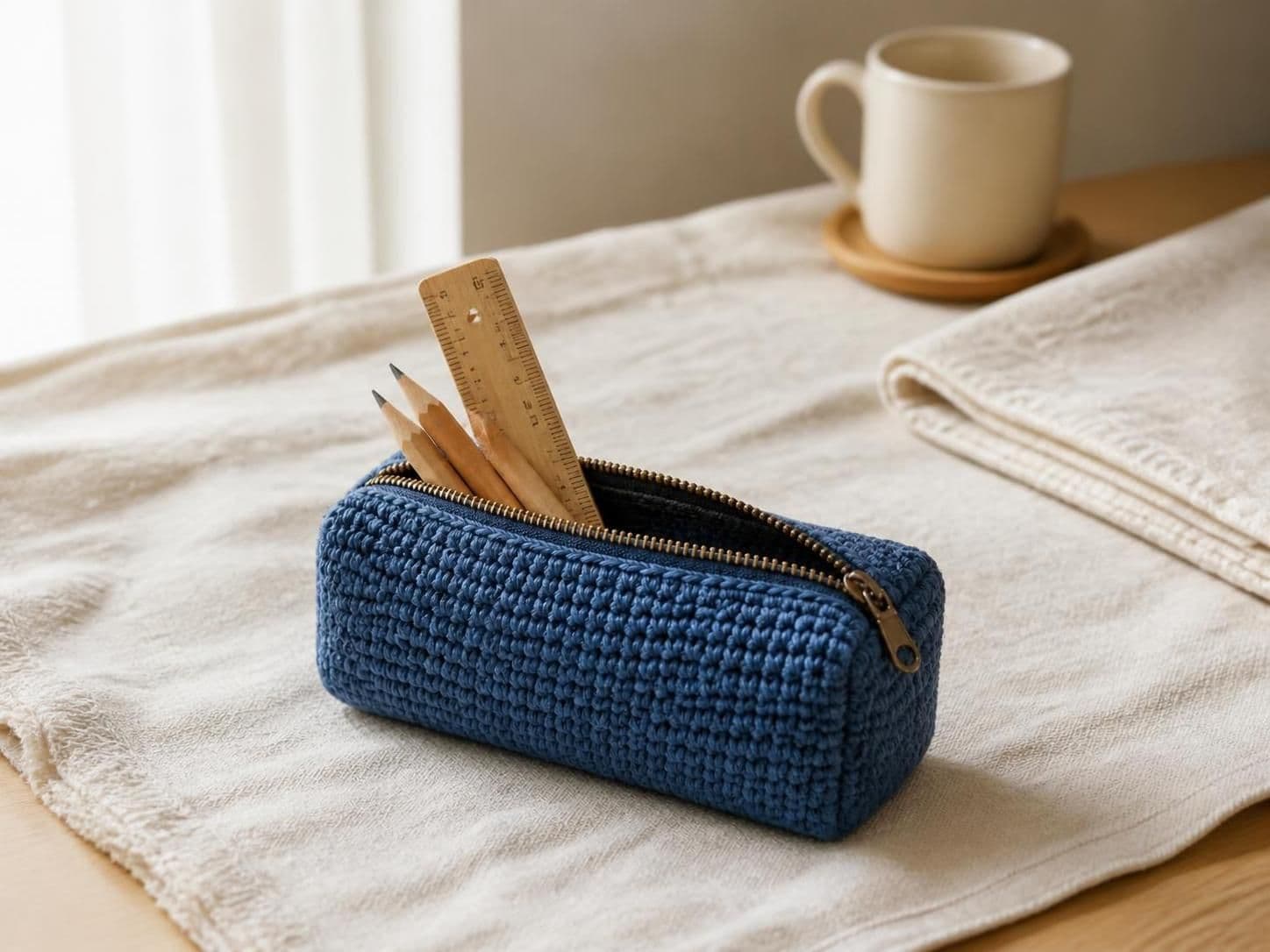
- Crochet pencil case: a boxy zippered case in half double crochet, great for notions and stitch markers.
- Ocean wave crochet coaster: a small tapestry project to practice carrying colors.
- Crochet phone bag: a bobble crossbody pouch with a snap flap.
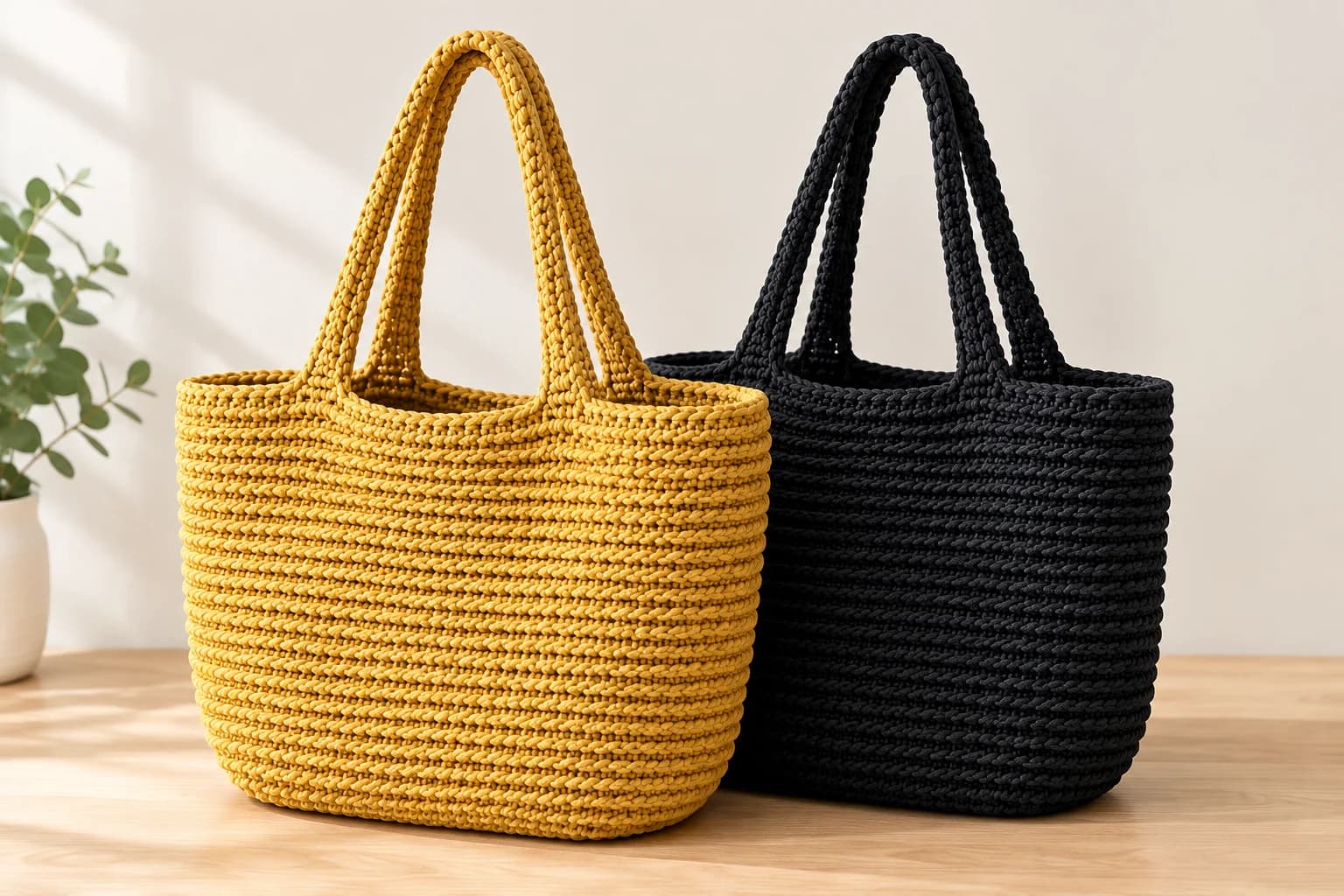
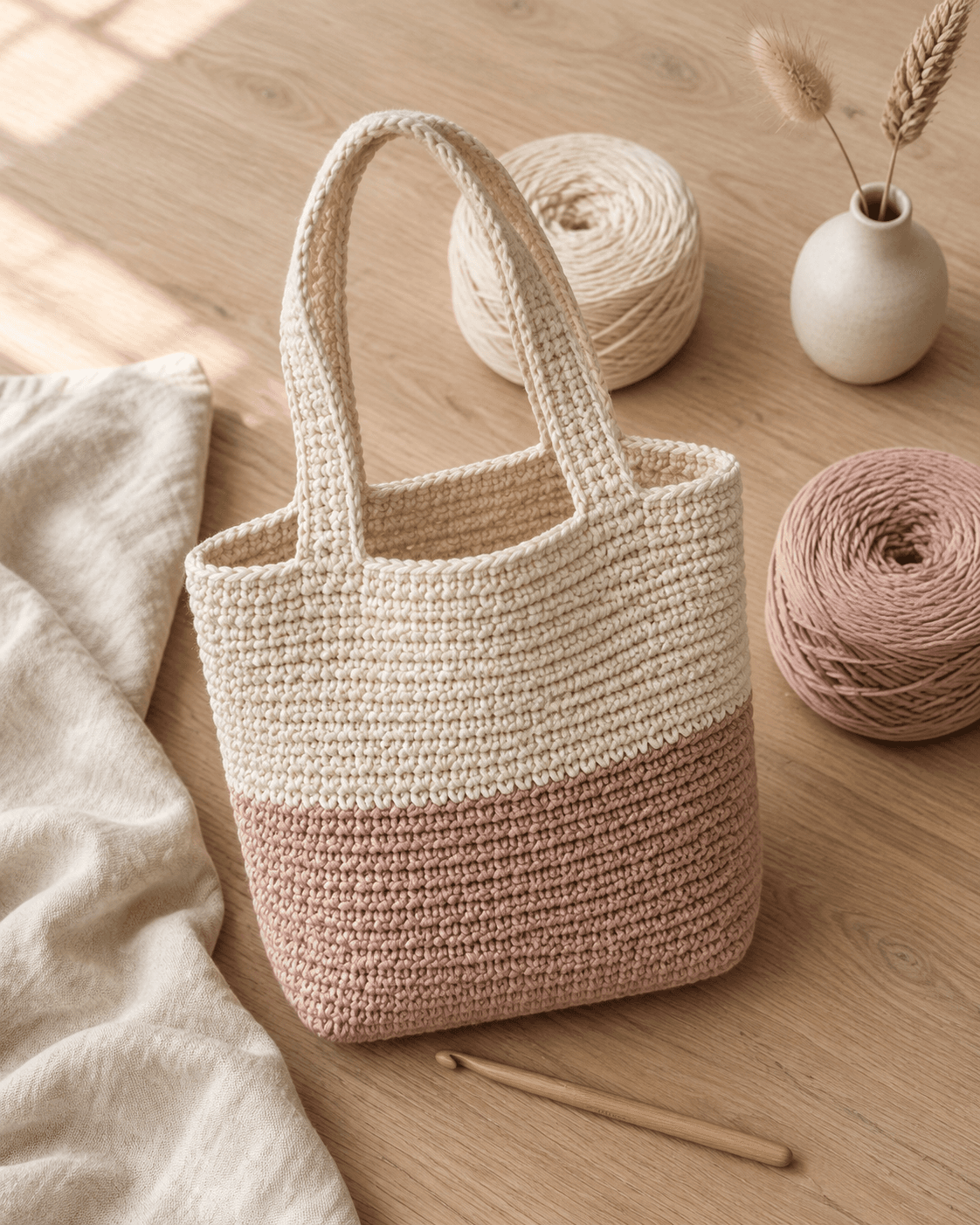
- Two-tone crochet tote bag: a big ribbed tote to carry your project and this case.
- Crochet bag patterns for beginners: six more weekend bags.
Made this hook case? Tag #wavodecrochet on Pinterest. I re-pin every finished make and credit the maker.
Pattern by Clara Hartwell for Wavode. Questions? Email me at support@wavode.com.