Crochet Baby Sneakers

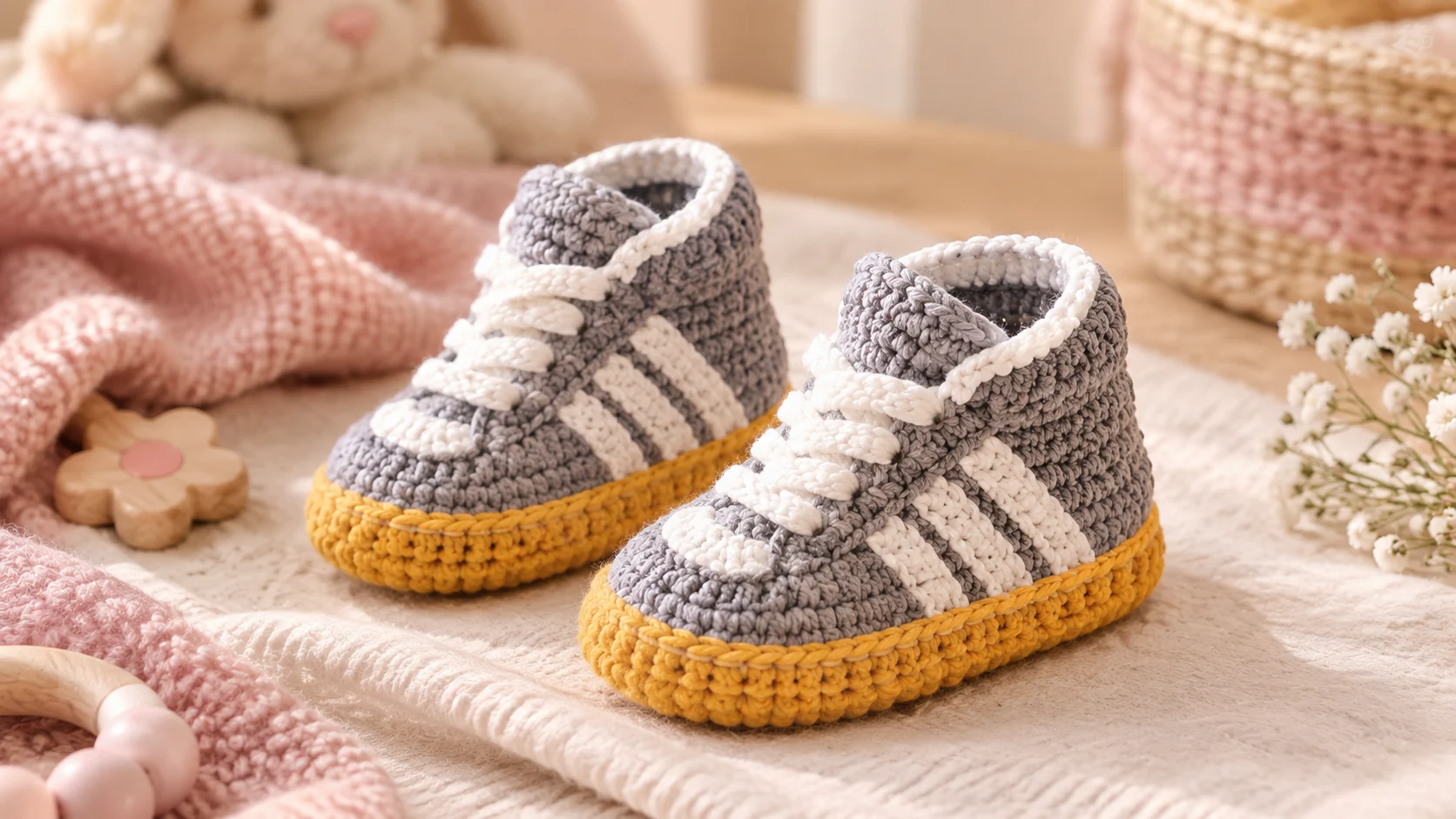
This free crochet baby sneakers pattern makes a pair of little high-top trainers in DK cotton on a 3.5 mm hook. Each one has a chunky mustard sole, a grey upper, three white stripes on each side, a padded white collar and real laces. You work each sneaker in one piece from the sole up, then add a tongue, stripes and laces. It comes in two sizes, 0–3 and 3–6 months, uses about 95 yards for the pair, and takes 4 to 5 hours.
Key Takeaways
- Sole and upper in one piece. The mustard sole turns straight into the grey upper, so there's no sole seam.
- Three colors, all DK cotton: about 25 yd mustard, 50 yd grey and 20 yd white for the pair.
- Stitches: chain, single crochet, sc2tog, back loop only and slip stitch.
- Soft soles for babies who aren't walking yet. Add non-slip dots once they start crawling.
About these crochet baby sneakers
Tiny sneakers are the baby gift everyone picks up and says "oh!" about. They look like real trainers, but they're soft, stretchy and warm, which is what a baby's foot needs before they walk.
The shape is simpler than it looks. You start with an oval sole, like most crochet booties. One back-loop round turns it up into a thick sidewall. Then the upper goes straight up in grey, with a few decreases to shape the toe. The high-top sides are worked in rows, which leaves an opening at the front for the tongue and laces.
The details are what make them look like sneakers: a chunky sole in a contrast color, white stripes sewn on the sides, and a white collar at the ankle. They also make the pattern easy to customize. Swap the colors and you've got a completely different pair.
Skill level. Advanced beginner. If you've made a pair of crochet booties, you can make these. What's new is working rows on part of a round, and sewing on small pieces neatly.
Looking for something even quicker? My crochet baby socks use the same DK cotton and hook, and my meadow baby crocs are a fun slip-on shoe.
A safety note about laces
Laces on baby shoes can be a choking or tangling hazard if they're long or loose. Keep them short, and tie them in a double knot. Once they're laced, sew each lace to the shoe at the bottom eyelet with a few stitches so it can't be pulled out. These sneakers have soft soles and are meant for babies who aren't walking yet. Never leave a baby asleep in them unsupervised.
What you'll need
Yarn (DK #3 cotton, for one pair)
- Mustard: ~25 yd (23 m) for the soles.
- Grey: ~50 yd (46 m) for the uppers and tongues.
- White: ~20 yd (18 m) for the stripes, collars and laces.
One 50 g ball of each color is plenty, and you'll have enough left over for a second pair. Why cotton: it's soft, breathable and holds its shape, so the sole doesn't stretch out.
Hook and notions
- 3.5 mm (US E-4) hook.
- 4 stitch markers.
- Tapestry needle.
- Optional: fabric puff paint or sew-on non-slip suede patches for the soles.
Gauge and sizes
Single crochet in rounds: 20 sts × 22 rnds = 4 in (10 cm).
That's the same gauge as my baby socks and newborn baby romper, so they make a matching set.
Instructions are written 0–3 months (3–6 months). Where there's only one number, it applies to both sizes.
- 0–3 months: sole about 3.5 in (9 cm) long.
- 3–6 months: sole about 4 in (10 cm) long.
The easiest check is the sole itself. After Round 3, it should measure about 3.5 (4) in long. If it's longer, go down to a 3 mm hook.
Abbreviations (US crochet terms)
- ch = chain
- sc = single crochet
- inc = 2 sc in the same stitch
- sc2tog = single crochet 2 together
- BLO = back loop only
- sl st = slip stitch
- st(s) = stitch(es)
- rnd(s) = round(s)
- RS = right side
UK crocheters: this pattern uses US terms. US single crochet = UK double crochet.
The pattern — step by step
Make two sneakers the same way. Work in joined rounds: end each round with a sl st into the first sc, and start the next with ch 1. The ch 1 doesn't count as a stitch.
Part 1 — Mustard sole
With mustard, ch 12 (14).
Rnd 1: Sc in the 2nd ch from the hook and in the next 9 (11) ch. 5 sc in the last ch. Rotate the chain and work along the other side: sc in the next 9 (11) ch, 4 sc in the last ch (the same ch as your first sc). Join. (28 (32) sts)
Rnd 2: Ch 1, 2 sc in the first st, sc in the next 9 (11) sts, inc in each of the next 5 sts, sc in the next 9 (11) sts, inc in each of the last 4 sts. Join. (38 (42) sts)
Rnd 3: Ch 1, sc in the first st, inc in the next st, sc in the next 9 (11) sts, [sc in the next st, inc] 5 times, sc in the next 9 (11) sts, [sc in the next st, inc] 4 times. Join. (48 (52) sts)
The toe is the rounded end with the 5 increases. The heel is where each round starts.
Rnd 4: Ch 1, sc BLO in each st around. Join. (48 (52) sts)
This round turns the flat sole up into a wall.
Rnds 5–6: Ch 1, sc in each st around. Join. (48 (52) sts) Fasten off mustard.
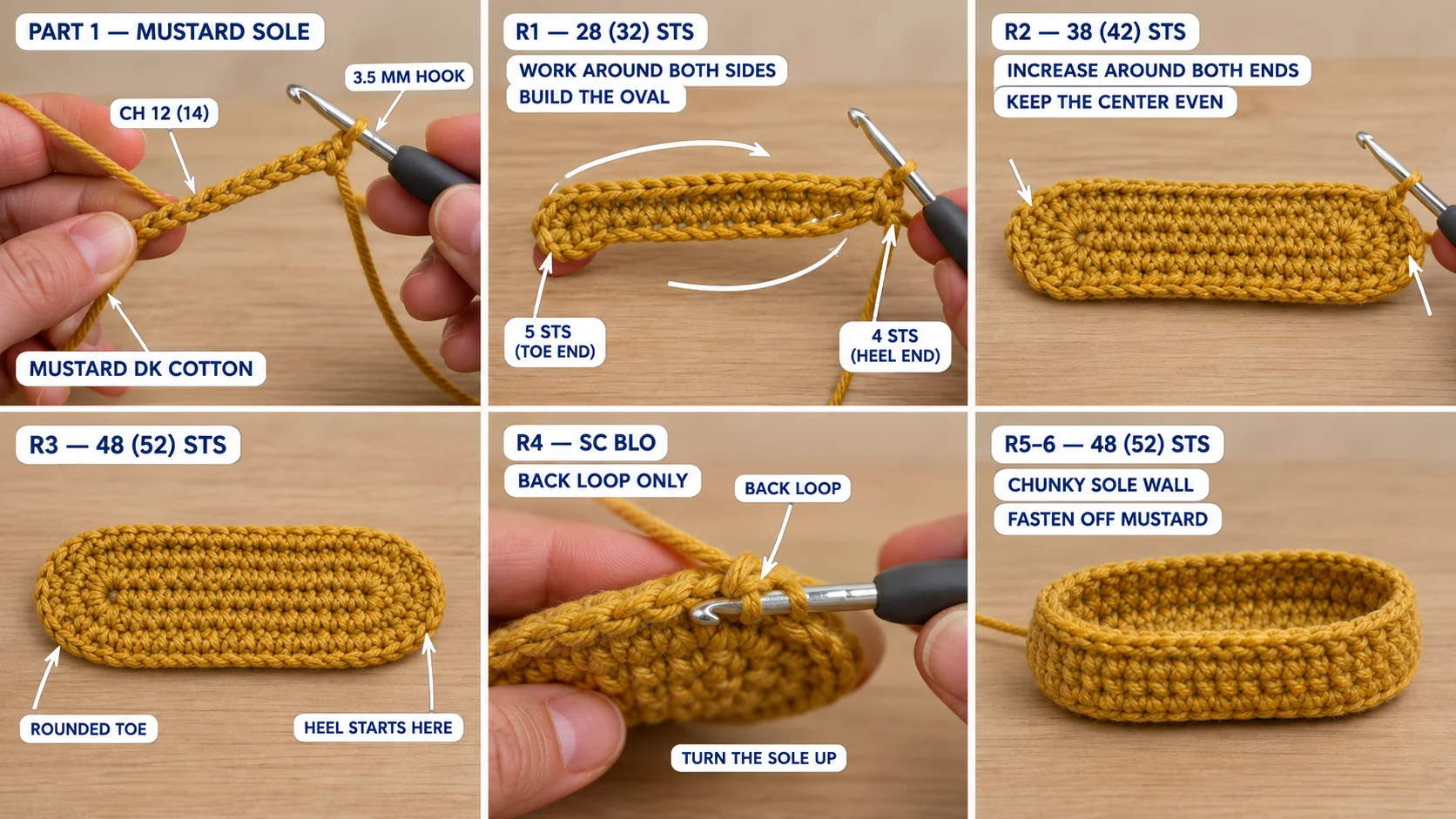
Why the thick sole wall? Rounds 4 to 6 give you three rounds of mustard standing up around the edge. That's what makes these look like chunky sneakers and not like booties. The back-loop round also leaves a neat ridge where the sole meets the side.
Part 2 — Grey upper and toe
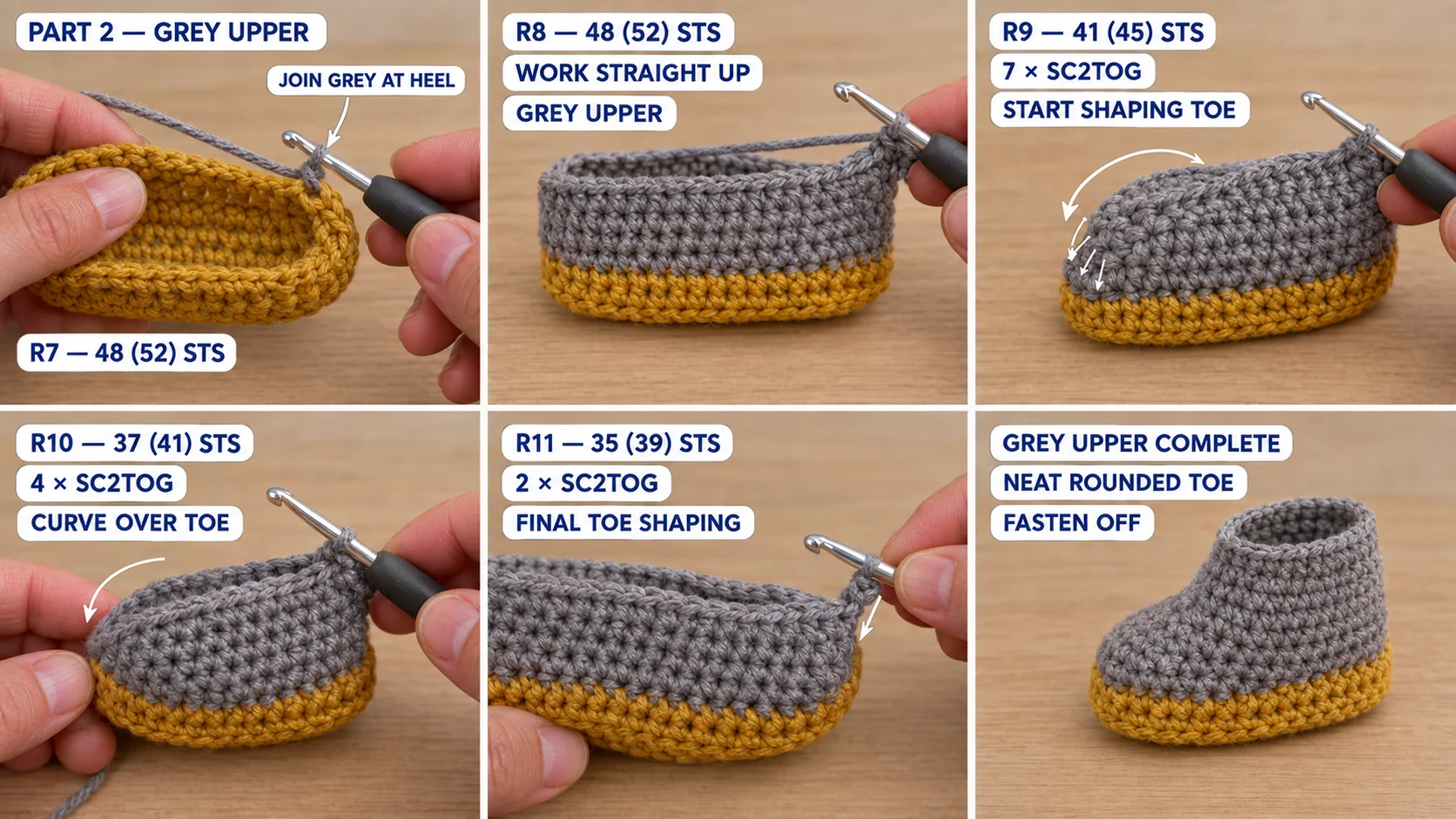
Rnd 7: Join grey in the first st (at the heel). Ch 1, sc in each st around. Join. (48 (52) sts)
Rnd 8: Ch 1, sc in each st around. Join. (48 (52) sts)
Rnd 9 (toe): Ch 1, sc in the first 12 (14) sts, sc2tog 7 times, sc in the next 22 (24) sts. Join. (41 (45) sts)
Rnd 10: Ch 1, sc in the first 12 (14) sts, sc2tog 4 times, sc in the next 21 (23) sts. Join. (37 (41) sts)
Rnd 11: Ch 1, sc in the first 12 (14) sts, sc2tog 2 times, sc in the next 21 (23) sts. Join. (35 (39) sts) Fasten off.
The front of the shoe now curves down neatly over the toe. The 2 decreases in Round 11 sit right at the tip.
Part 3 — High-top sides and tongue
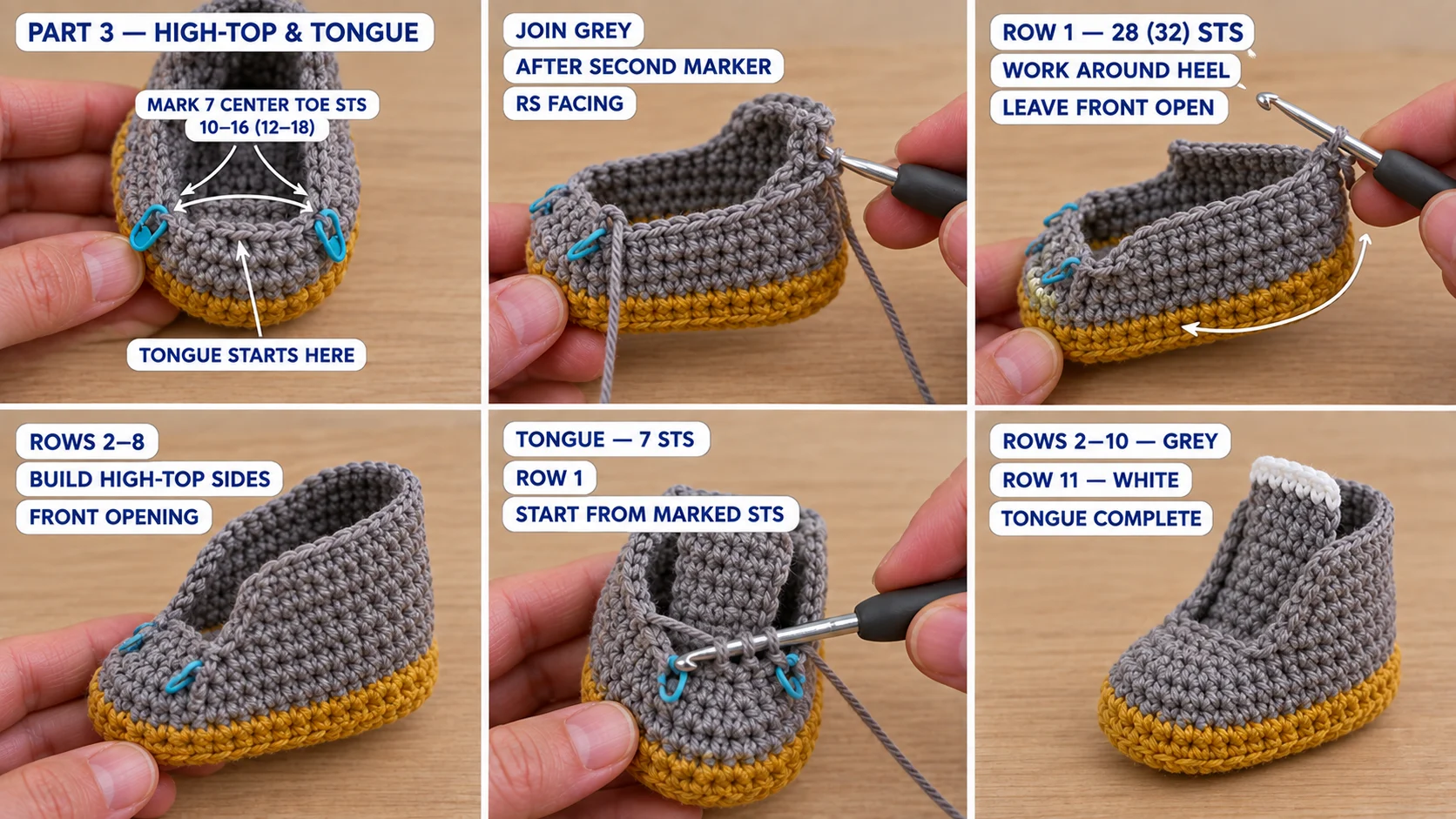
Mark the front. Count the 7 sts at the center of the toe, which are sts 10–16 (12–18) of Round 11. Put a marker in the first and last of those 7. The tongue grows from these stitches later.
High-top sides: With the RS facing, join grey in the stitch after the second marker.
- Row 1: Ch 1, sc in the same st and in each st around the heel, stopping at the stitch before the first marker. Turn. (28 (32) sts)
- Rows 2–8: Ch 1, sc in each st across. Turn. (28 (32) sts)
Fasten off. You now have a high-top with an opening at the front.
Tongue: With the RS facing, join grey in the first marked stitch.
- Row 1: Ch 1, sc in each of the 7 marked sts. Turn. (7 sts)
- Rows 2–10: Ch 1, sc in each st across. Turn. (7 sts)
- Row 11: Change to white. Ch 1, sc in each st across. Fasten off.
The tongue stands up inside the opening, a little taller than the sides.
Part 4 — Collar, stripes and laces
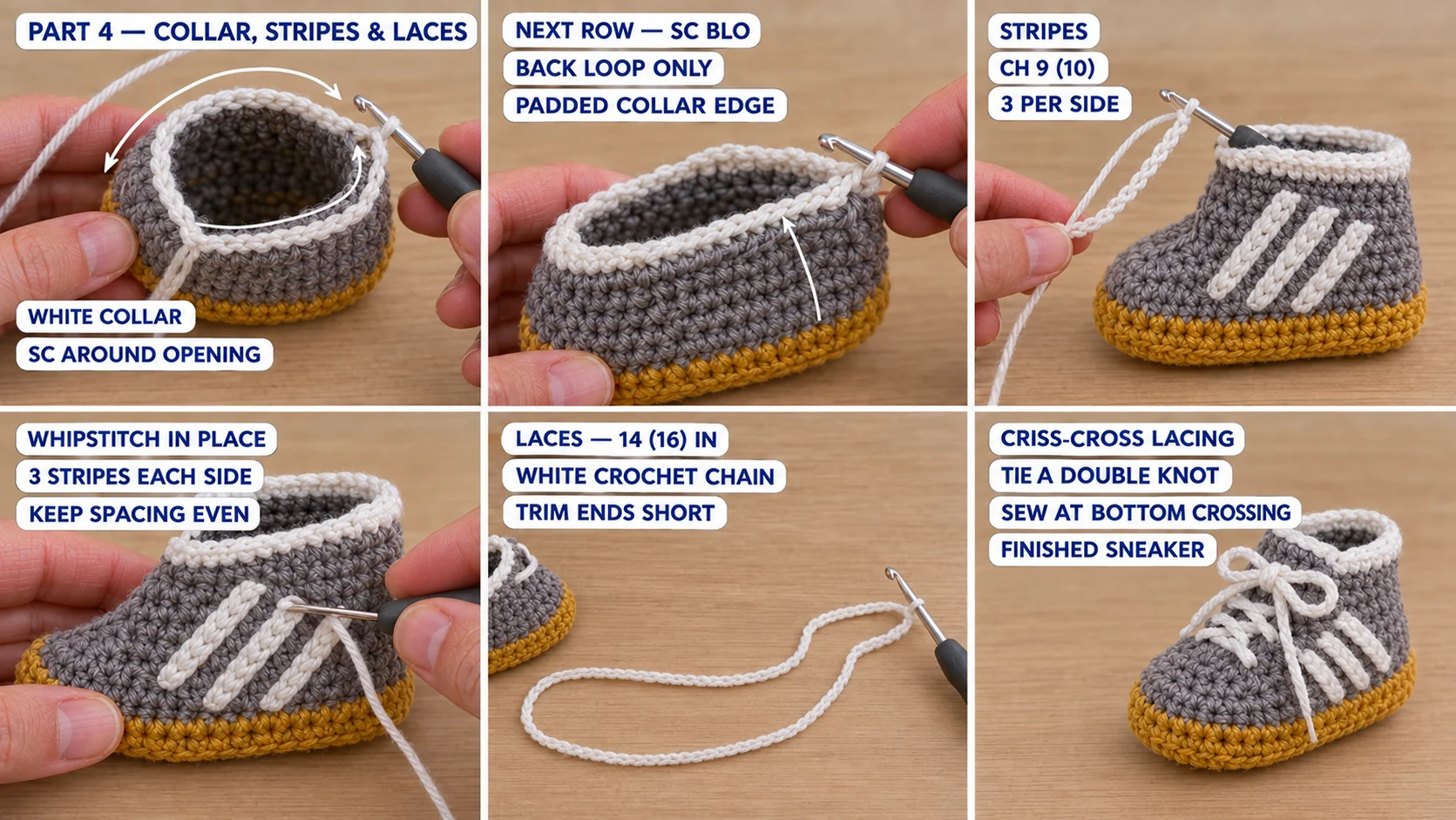
White collar: With the RS facing, join white at the bottom of one side of the front opening. Sc evenly up that front edge, 3 sc in the top corner, sc across the top of the sides and around the heel, 3 sc in the other top corner, then sc down the other front edge. Turn.
- Next row: Ch 1, sc BLO across the top edge only, from one front corner around the heel to the other. Fasten off.
The back-loop row rolls out slightly, like the padded collar on a real sneaker.
Stripes (make 6 per sneaker, 3 for each side): With white, ch 9 (10). Sc in the 2nd ch from the hook and in each ch across. (8 (9) sts) Ch 1, turn, sc in each st across. Fasten off, leaving a 6 in tail.
Place three stripes on each side, slanting from the mustard sole up toward the front opening, with about 0.25 in between them. Whipstitch them down all the way around.
Laces: With white, make a chain about 14 (16) in long. Fasten off and trim the ends short.
Thread the lace in a criss-cross up the front opening, going through the white collar edge about every 3 rows, like real shoelaces. Tie it in a bow and knot it. Then sew each lace to the shoe at the bottom crossing, following the safety note above.
Finishing
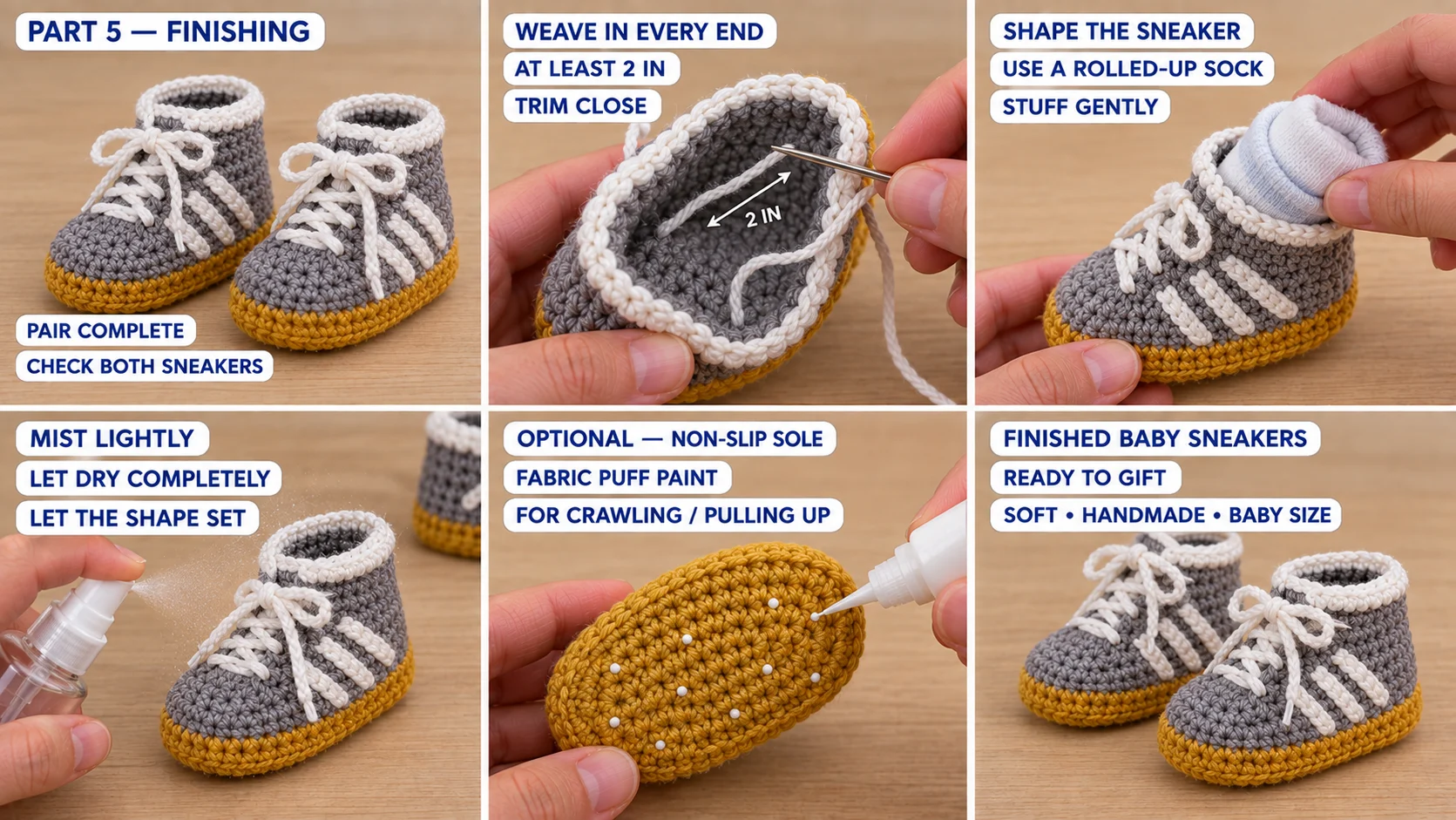
- Weave in every end on the inside for at least 2 in, then back the other way. Trim close, so nothing rubs on baby's foot.
- Shape them: Stuff each sneaker with a rolled-up sock, mist it lightly with water and let it dry. The sole and high-top will hold their shape.
- Optional — non-slip soles. Once baby starts crawling or pulling up, add dots of fabric puff paint to the mustard sole, or sew on a suede patch.
Make it yours — quick variations
- Low-tops: Skip Rows 2–8 of the high-top sides and work just 2 rows. Make the tongue 5 rows and the laces 10 in long.
- Other colors: Try navy with a white sole and red stripes, all white with a gum-brown sole, or blush with a cream sole.
- Velcro-look strap: Skip the laces. Crochet a 5-stitch strap in white, sew one end to the side, and close it with a snap on the other side.
- Name stripe: Replace the three stripes with one wide white strip, and embroider a letter or a tiny heart on it.
Troubleshooting
The sole is cupping or ruffling
Cupping means you've missed an increase, so count after each round: 28 (32), 38 (42), 48 (52). Ruffling means your tension is loose around the curves. Go down to a 3 mm hook.
The toe looks pointy
Your toe decreases are off-center. The 7 decreases in Round 9 should sit over the 15 sts of the rounded toe. If they've shifted, check that you started each round at the heel.
The high-top sides lean outward
The white collar is looser than the grey rows. Rework the collar with a 3 mm hook, or skip the back-loop row and just do the sc edge.
Frequently asked questions
What size are these crochet baby sneakers? The 0–3 month size has a sole about 3.5 in (9 cm) long, and the 3–6 month size about 4 in (10 cm). For a gift before the birth, make the 3–6 month size. Babies grow fast, and soft crochet shoes can take a little extra room.
How much yarn do I need? About 95 yd for the pair: 25 yd of mustard, 50 yd of grey and 20 yd of white DK cotton. One 50 g ball of each color is plenty, with enough left for a second pair.
Can babies walk in these? No. They have soft crochet soles and are made for babies who aren't walking yet. Once your baby starts crawling or pulling up, add non-slip puff-paint dots or suede patches to the soles. Walkers need proper shoes with a firm sole.
Are the laces safe? They're safe when they're short, double-knotted and sewn to the shoe at the bottom crossing. That way they can't be pulled out or come loose. Check them before every wear, and don't leave a sleeping baby in them unsupervised.
Can I use acrylic yarn? Yes, soft baby acrylic works and is easy to wash. Cotton holds the sole shape better and breathes better, though. If you use acrylic, choose a DK labeled for babies and check that your sole matches the size after Round 3.
Can I sell sneakers made from this pattern? Yes, you're welcome to sell finished sneakers made from this free pattern at markets, on Etsy or as gifts. Please credit "Pattern by Wavode" on your listing and link back to this page. What you can't do is republish this write-up or my photos as your own pattern.
Related patterns on Wavode
- Crochet baby socks: same DK cotton and gauge, with a ribbed cuff.
- Meadow baby crocs: slip-on baby clogs with a flip-back heel strap.
- Rosebud baby booties: classic booties with a little bow.
- Newborn baby romper: a sleeveless button-strap romper to complete the outfit.
Made these sneakers? Tag #wavodecrochet on Pinterest. I re-pin every finished make and credit the maker.
Pattern by Clara Hartwell for Wavode. Questions? Email me at support@wavode.com.